Sculpture between matter and spirit
Tagli e Legami —
the wound that opens,
the bond that holds
A selection of the most representative works: from the large iron-and-concrete pieces of the Tagli e Legami series to sacred art for churches and cemeteries, through to the early figurative works.Tap a work to open it; every work has its own page.
«Matter lives the space that inhabits it and enters into dialogue with light. Lacerations and bonds are not accidental: they become a narration of the real, the manifestation of a mystery that lives in us and communicates life.» Sister Maria Gloria Riva — on the Tagli e Legami series
«Cuts and Bonds»: the mature language of the artist. The cut as a wound that opens onto an Beyond, the bond that holds matter together — iron, concrete, bronze and raku for a modern, anti-rhetorical spirituality.Tap an image to view it full size.
Preparatory studies in raku terracotta and gold leaf for the large compositions.
Cappella Fondazione Adele Bonolis · Vedano al Lambro (MB)
The most recent Stations of the Cross, in terracotta: fourteen stations modelled with essential, contemplative gestures.
In memoria di Rino Perego (bronzo) · Cappella Gesù a Nazareth, Milano (terracotta)
The 2006 cycle of the Stations of the Cross, where the figurative root and the new language of the cut meet.
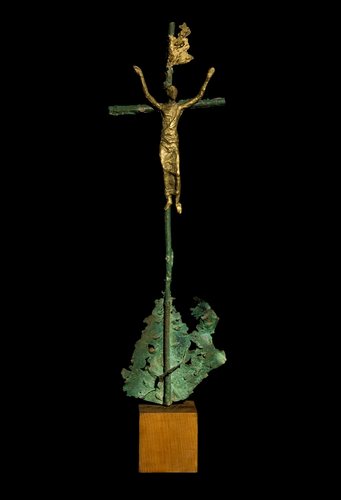
Sacred art from 1983 to today: Christ, the Risen One, the Mother, the icons — works for churches and private devotion.
Altars, tabernacles, lecterns and liturgical furnishings designed for the celebration.
Small brass studies: essential figures of the virtues — steadfastness, the shield, hope, tension, donation. Large-scale works to follow.Tap a work to open it.
Chalices and patens in bronze, brass and gilded wood.
Stained-glass windows for churches and the Lambrate cemetery in Milan: light becoming image.Tap an image to view it full size.
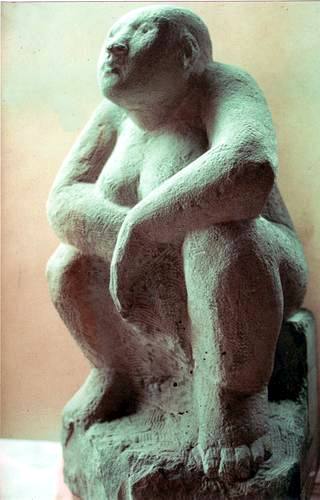
The origins (1980–1985): Waiting, Lovers, Rest — figures of stillness and tenderness that seek presence rather than likeness.Tap an image to view it full size.
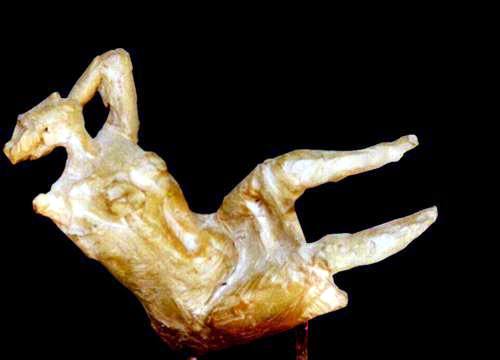
From 1985 to 1993 the compact masses begin to lighten, the form opens, movement enters the stone.
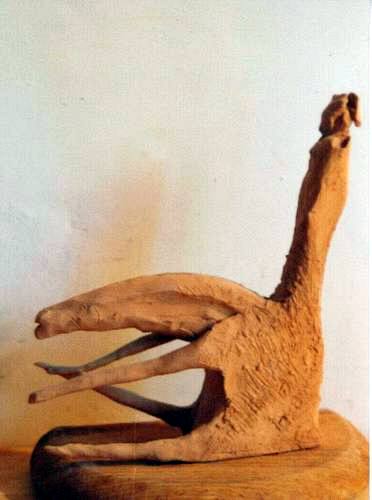
Horse and rider: an image of strength and fall, of resurrection of the flesh.
Preparatory drawings and studies: projects for altars and liturgical furnishings, notes of measure and matter.Tap an image to view it full size.
Circular raku terracotta plates, their white and black surfaces marked by smoke: Christological symbols — the fish, the ear of wheat, the sun.
Pasquale Lo Moro was born in Zungri, Calabria, in 1959. At twenty he moved to Milan to follow his passion: sculpture. He studied at the Brera Academy of Fine Arts, where academic training intertwined with a fertile nostalgia for his southern roots. From that tension came his first works: figures that seek not likeness but presence, stillness, the beauty of the people he had left behind.
In the years after Brera, the encounter with a group of Milanese artists and with the master Nicola Sebastio marked a turning point. Sebastio recognised in his sculptures a quality Lo Moro himself had not yet named: the sacred. From that moment sacred art became one of the deepest strands of his work, with liturgical furnishings and cycles for churches in Brianza and the Milan area.
In over forty years of continuous work — «since 1980, without interruption» — Lo Moro has moved through figurative sculpture and sacred art, and then taken the risk of a new language with the series Tagli e Legami. A path driven not by fashion but by inner necessity: «to make visible, through beauty, the centrality of Christ in the path of man».
He models clay, carves stone, casts bronze and brass, works plaster, concrete, wood and raku terracotta. Matter is never a mere support: it is the place where he can «make beauty visible, give life where there seems to be nothing».

«A sculptor renders the beauty of the world visible, with whatever material he works. He gives life where there seems to be nothing.»
— Pasquale Lo Moro
A wound that traces a Beyond: the opening through which to reach the heart of God.
— Sister Maria Gloria Riva · on Pane Spezzato
Utterly anti-rhetorical forms of modern spirituality, inviting believers and non-believers alike to consider the sacred.
— G. Seveso · catalogue introduction
The first to recognise the sacred dimension of these sculptures — and not to let him go until the artist realised it too.
— on Nicola Sebastio, his master
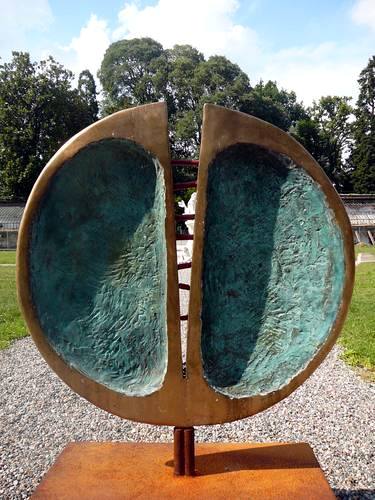
«The humble, white bread of the Sacramentum charitatis is rendered through the persuasive force of bronze. A wound that traces a Beyond: the slit through which to reach the heart of God.»
Read more→«Lo Moro invites believers and non-believers alike to turn a thought to the dimension of the sacred. He finds forms that are utterly anti-rhetorical and of a modern spirituality.»
Read more→He was the first to recognise the sacred dimension of these sculptures, declaring that he would not let him go until the author himself realised it too.
Read more→«Crucis Misterium» — International exhibition of contemporary art.
«Profezia di Bellezza» — Sacred art between memory and project.
For information on the works, purchase enquiries, sacred-art commissions, loans for exhibitions or museum acquisitions, write or call. You will be contacted as soon as possible.

The protagonists of Pasquale Lo Moro’s latest works are space and light. Matter inhabits the space around it and enters into dialogue with light. That is why the softness of planes, the points of friction, the lacerations and bonds are not accidental but — while respecting technical solutions — become a narration of the real, the manifestation of a mystery that lives within us and communicates life.
The humble, white bread of the Sacramentum charitatis par excellence is thus rendered through the persuasive force of bronze, a material that carries within it the incandescent memory of fire. The parallel is already evocative: the Eucharistic bread too is the incandescent memory of a fire of charity that burned in the heart of the Saviour. Lo Moro contemplates this bread in the solemn, meaning-laden moment of its breaking, of its giving itself to all.
The opening reveals bonds that are also shreds of laceration. Christ, on the one hand, holds us all bound through his Bread, his sacrifice; on the other, in the very gift he makes of himself, he bears witness to an absolute, indestructible bond between God and his creature: the Word became Flesh. For this reason the circularity of the bread — a symbolic reference to eternity — has a hollowed surface, like a womb that welcomes, nourishes and shapes.
The Eucharist shapes us for eternal life, welcomes us into its womb to give us form — the form of that body which already lives in eternity and in the supreme bliss of love: Christ. And while you contemplate that womb in Pasquale’s works, you are immediately drawn to the deep wound of the breaking host. A wound that traces a Beyond: the passage through which to observe the world, the slit through which to reach the heart of God, discovering — hope against all hope — his good design upon the world.
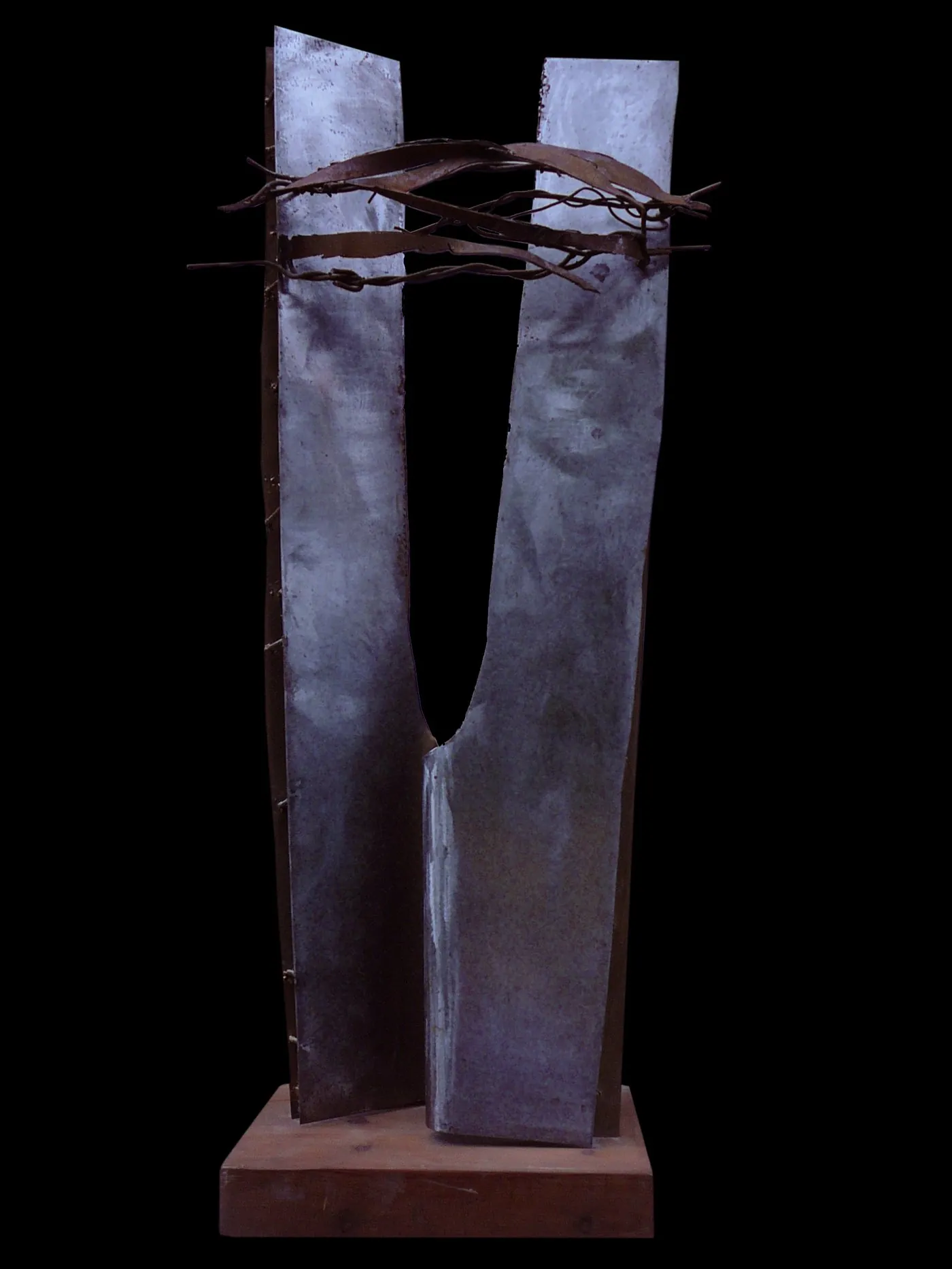
The work was born from a visit to the cathedral of Orvieto. Returning from a meeting in Rome with Mons. Mauro Piacenza, we stopped to thank the Lord for such a beautiful encounter and for the work done with the friends of «Il Baglio». Always struck by miracles, in its simplicity I believe my work too is a small miracle.
The work — explicit, I believe, in its configuration — affirms the centrality of the body of Christ in the Church, present today among us. The cross is par excellence the Mystery that lives in us and communicates life: the narration of a dramatic reality that nonetheless leads to a beyond of hope.
From this, I wanted to re-read the Mysterium Crucis in its daily actualization, in the Eucharist. The inevitable fracture, sign of the donation of the perpetual rite, is the guiding thread of all my work in recent years.
In daily life, cuts, fractures and breaks are stigmatized and avoided, if not hidden as a source of shame, preferring to turn the page and start over — and in this way losing the beauty of what one does. People are unwilling to make the effort to mend relationships, because that means putting oneself on the line, and they are not willing to face one another.
Pasquale Lo Moro invites — believers and non-believers alike — to lift their gaze to the sky and to turn a thought to the dimension of the sacred and the transcendent.
By his intimate vocation, Lo Moro has always placed his research and his plastic sensibility predominantly at the service of an art with a sacred vocation: a vocation for which he finds forms that are utterly anti-rhetorical and of a modern spirituality.